

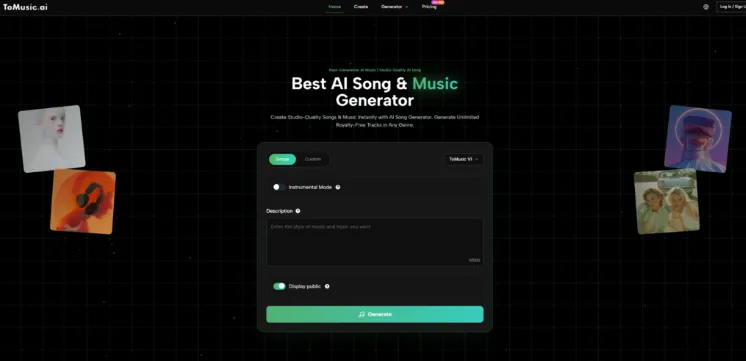
You have words in your notes app that feel like they want to be a chorus, but the melody never arrives on command. If you are stuck between “I can write” and “I can produce,” an AI Music Generator can act like a bridge: not a finished identity, but a quick way to hear your lyric ideas as real musical drafts.
Why Lyrics Alone Can Feel Like a Dead End
The pain
Lyrics can be emotionally clear while the music stays undefined.
What makes it worse
When you cannot hear the rhythm and contour, you rewrite endlessly, and the original feeling fades.
The shift
Instead of forcing a full composition, you can prototype: generate a few musical directions, then choose the one that matches your lyric’s intent.
The honest expectation
You are not outsourcing artistry. You are accelerating the first “listen” so you can react faster.
A Practical Way to Use Text-to-Song Without Losing Your Voice
Start with the lyric’s job
Ask what the lyric is trying to do:
- Confess
- Celebrate
- Taunt
- Comfort
- Tell a story
Then set the musical frame
Choose constraints that support that job:
- Tempo range (slow, mid, fast)
- Genre neighborhood (indie pop, R&B, folk, electronic)
- Vocal presence (lead vocal, airy vocal, no vocal)
Then generate multiple takes
The best approach is to treat output like demos:
- One version that is minimal
- One that is rhythm-forward
- One that is harmony-forward
- One that pushes into a different genre
Finally, revise your words
Once you hear phrasing and cadence, you will often discover:
- Which lines are too dense
- Where a chorus wants repetition
- Which vowels sing better on sustained notes
Model Choice as a Creative Lever
ToMusic presents multiple model versions, which is useful because songwriting has different phases.
Phase 1: Exploration
You want variety, fast.
Phase 2: Arrangement
You want structure, supporting parts, and a coherent arc.
Phase 3: Vocal believability
If you are generating vocals, you will care about articulation and tone.
Phase 4: Editing control
If your workflow includes mixing, options like stems or removing vocals can help you reshape the draft around your own recording.

A Songwriter’s Comparison Table
| What you need | Text-to-music workflow | Writing in a notebook only | Producing in a DAW immediately |
| Hear the lyric as a song fast | High | Low | Medium (depends on skill) |
| Try multiple genres easily | High | Low | Medium (time cost) |
| Keep your lyric identity | High if you steer prompts and edit | High | High |
| Learn what the lyric wants musically | High | Medium | High |
| Avoid getting stuck on production details | High | High | Low |
| Best for | Demo discovery and direction | Drafting meaning and imagery | Final-quality control |
A Prompt Pattern That Protects Your Writing
1. Put the lyric first
Paste the lyric or a verse plus chorus.
2. Describe the emotional arc
For example: “starts restrained, opens up in the chorus, ends quietly.”
3. Describe the vocal attitude
“Intimate, close-mic, slightly breathy” or “clean, energetic, pop-forward.”
4. Add one musical reference, not five
One clear anchor is better than a pile of contradictory adjectives.
What You Might Not Like (And Why That’s Useful Data)
Sometimes vocals feel slightly uncanny
That can happen in AI singing. Treat it as a sketch, then decide whether you want to:
- regenerate with different phrasing constraints
- switch to instrumentals and record your own vocal
- use the draft to write a topline you will later perform
Sometimes the melody is good but the words feel crowded
That is normal. If anything, it reveals where your lyric is fighting the rhythm.
Sometimes you get a great chorus and a weaker verse
That is not failure. It is a map: keep the chorus and rewrite the verse to match its energy.
Sometimes you need three to eight tries
If you plan for iteration, you stop feeling disappointed and start feeling in control.

A Balanced Way to Think About Ownership and Use
Tools often bundle commercial licensing with paid tiers, but “can I monetize” and “is it copyrightable” are not always the same question across jurisdictions. If you are releasing music seriously, treat the output like a demo pipeline and double-check your distribution needs.
A neutral reference point
Academic reviews of text-to-music systems commonly note that aligning musical structure precisely to text intent remains a hard problem, even as models improve. That matches the lived reality: you will still refine prompts and make taste decisions.
The takeaway
Use generation to hear possibilities, then write like a human again.
The best outcome
You are no longer waiting for inspiration to arrive fully formed.