

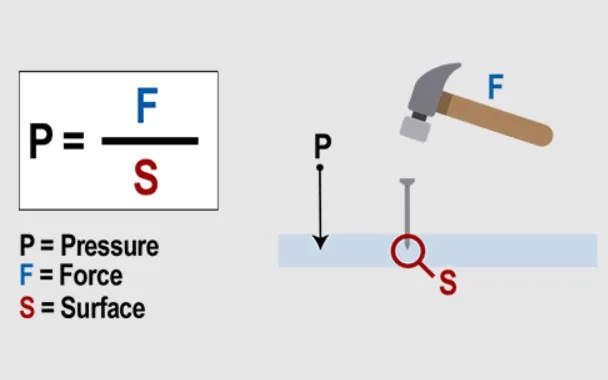
Pressure – a measure of how much force acts upon a given area – plays a fundamental role in engineering, physics, and all manner of day-to-day applications, such as hydraulic systems and tyre inflation.
Global Collaboration Calls for Frequent Pressure Unit Conversions
Engineering, of course, is a very much global field of endeavour. Major engineering projects, then, frequently involve collaboration across various regions of the world. This, in turn, underscores the importance of ensuring consistency across different regions.
This brings us onto the topic of when you might need to convert between units of pressure such as pascals (Pa) and pounds per square inch (PSI). Below, then, we will set out the key things an engineer needs to know about pressure unit conversions.
A Quick Introduction to Pressure
In the words of BBC Bitesize, “pressure is a measure of how concentrated (or spread out) a force is.” The same source goes on to explain that the amount of pressure exerted on a given object is dependent on the force applied and the surface area over which it is spread.
Pressure can also be defined by reference to a simple formula, P = F / A, where those letters refer to pressure, force, and area respectively.
Why Is It So Important to Convert Units of Pressure?
Here are some of the reasons why engineers need to know how to convert pressure units, whether they do so manually or with a pressure unit converter like the various calculation tools that can be found online:
· Global Standards
Across different industries and parts of the world, there is a tendency to use different units of pressure. For example, while Pa and bar tend to be the “go-to” units of pressure in Europe and for scientific applications, when it comes to automotive engineering in the United States, it is PSI that is frequently used.
· System Compatibility
If there is a mismatch between the units used for a given application, this can lead to critical system design errors, such as incorrect pressure ratings for valves or pipes. This can then heighten the likelihood of failures or safety hazards.
· Interdisciplinary Work
Engineers often work across multiple domains, such as mechanical, civil, and chemical engineering. As they do so, they will need to ensure consistent units when performing calculations in relation to the likes of fluid dynamics or structural stress.
How Do Pascals and PSI Relate To Each Other?
Although various units have long been used to measure pressure, discussions on this topic tend to centre on the distinction between Pa and PSI:
· Pascal is the SI (International System of Units) unit of pressure and stress. This unit, named after Blaise Pascal (1623-1662), represents the force of one newton applied over an area of one square metre. A single pascal, then, is the same as one newton per square metre (1 N/m2), and equivalent to 1.45038×10⁻⁴ PSI.
· Pound per square inch is an imperial unit of pressure. It is a widely used pressure unit, particularly in the United States, where nearly all pressure instruments are specified and display in PSI. A single PSI is equal to 6,894.76 pascals.
How, Then, Do You Convert Between These Units of Pressure?
It could certainly be useful for an engineer who may need to convert pressure units to familiarise themselves with the key conversion formulas, which are:
· Pa to PSI: PSI = Pa / 6894.76
· PSI to Pa: Pa = PSI x 6894.76
However, as we touched on above, various conversion tools exist. You might find a reputable one online, such as on the website of the electrical components supplier, RS.
Pressure unit converters are also incorporated into some broader software packages, such as certain CAD platforms.
In summary, when it comes to ensuring the greatest precision – and therefore the optimal results – across all manner of global engineering projects, it is of the utmost importance to understand not only the various common pressure units, but also how to quickly and accurately convert between them.