


The fractional CMO vs. fractional growth team debate when choosing an option to scale your SaaS business is not easy. Both options have their advantages and disadvantages depending on your overall business objectives.
However, many SaaS companies face the challenge of wanting to grow their businesses while having limited resources. Struggling to choose between a leadership-first and execution-first model can pressure you into making the wrong decision.
In this article, we will provide all the information you need to understand the opportunities that lie in fractional CMO services, and how AlgocentricDigital’s approach to fractional growth can get you to the next phase of your business journey.
What a Fractional CMO Is Designed to Do
Hiring a fractional CMO is a good business decision if you are looking for someone to take strategic ownership of your entire marketing. Fractional CMOs have extensive knowledge and experience in marketing, enabling them to own their strategies from creation to implementation.
Also, fractional CMOs can provide GTM alignment with founders and leadership. Oftentimes, the GTM strategy is not as efficient as it could be because founders and leadership are not aligned with the rest of the company. Involving everyone in the process ensures transparency and clarity.
What a Fractional Growth Team Looks Like in Practice
Unlike fractional CMOs who have leadership marketing knowledge, a fractional growth team consists of channel specialists. They are focused either on paid marketing, SEO, lifecycle marketing, or CRO as their primary marketing channel. Typically, they are agency-led or freelancer-heavy execution, which implies that one person will be specialized in only one area.
Typically, such marketing professionals are hired when you need help with a specific campaign or want to focus only on one marketing area. Also, such a choice makes the most sense when you require additional strength in speed and experimentation.
However, hiring a fractional growth team implies certain weaknesses, such as coordination and long-term direction. Unfortunately, such professionals are not experienced enough in creating long-term strategies or having a business vision that would take your company to the next level.
Where a Fractional CMO Outperforms a Growth Team

To understand what makes one option better than the other for your business, you will need to clarify your business objectives first. If you are looking for clear prioritization and focus, it makes more sense to hire a fractional CMO. They will dedicate themselves to maximizing all opportunities for your business, whereas a growth team will not be able to have this wider perspective.
If one of your goals is to avoid channel sprawl and instead build a sustainable and scalable system, an experienced fractional CMO can help you with that. Because of their extensive knowledge and experience, they have the right skill set to ensure long-term scalability and system development, whether you already have one in place or wish to build it from scratch.
A fractional CMO can ensure their marketing strategy is aligned with your revenue and business objectives, but more importantly, they can identify opportunities which a business owner might overlook.
Where a Fractional Growth Team Outperforms a Solo Fractional CMO
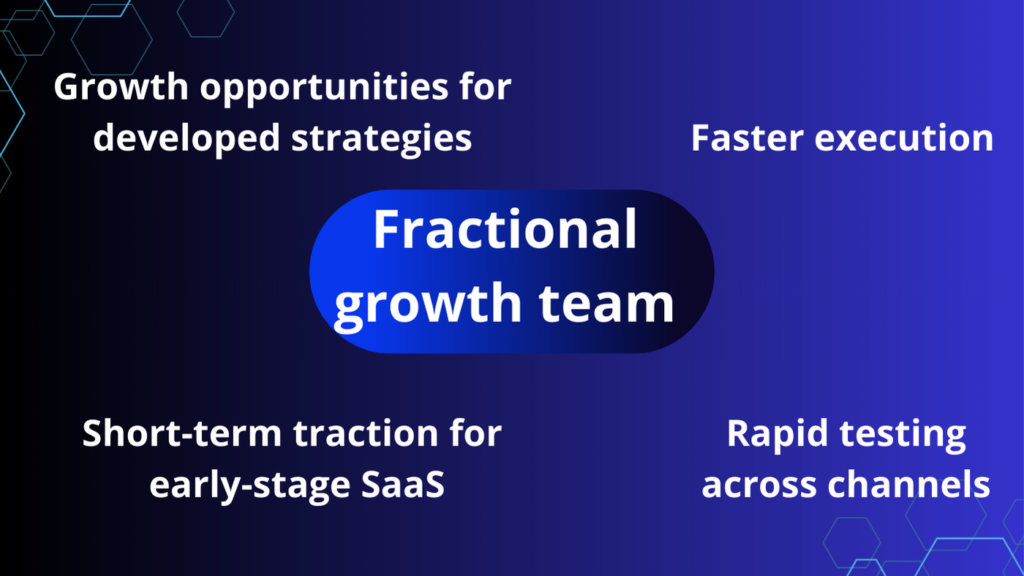
If you are looking for faster execution and need immediate actions that will bring you quick wins, you will benefit more from a fractional growth team. Because they focus on a specific area, they can deliver quick results.
They can also perform rapid testing across your channels and provide you with valuable insights on what works and what doesn’t. Such testing can also help you get to know your target audience a bit better.
If you have an early-stage SaaS company, you will probably want to gain short-term traction, which is one of the biggest values of a fractional growth team. Unlike large SaaS businesses, new companies can’t allow themselves to spend money and time building detailed and long-term strategies, so short-term traction can slowly but steadily help reach the level of success you want.
Strategy Without Execution, or Execution Without Strategy
While going through this list of upsides and downsides of both fractional CMos and growth teams, you might have already thought about how difficult it would be to create a strategy without execution or ensure execution without a proper strategy in place. This is where most SaaS companies make their biggest mistake.
Contrary to what you might assume, you don’t have to choose just one model. If you do so, the cost of misalignment and the time you will spend looking for resources to cover missing parts of your marketing could lead to disaster.
Apart from that, you could find yourself struggling to grow as a company. After all, strategy and execution are two sides of the same coin. If you wish to succeed, you will need to find a way to integrate both into your business approach.
The Hybrid Model That Actually Scales SaaS Companies
Combining execution with leadership will provide both short-term and long-term results. When you position your fractional CMO as a growth architect, their strategy can guide the growth team in the right direction.
Even if you have a limited budget, you can easily opt for a hybrid model, knowing that it is saving you money in the long run. Choosing to work only with a growth team will eventually require investing money into someone with leadership skills to steer your marketing towards success.
How SaaS Founders Should Choose the Right Model
There are certain factors you should keep in mind if you want to choose the right model for your business. First, you will need to consider the stage your company is at. This will help you determine the needs you want marketing to meet. If you have an internal team, it is important to assess their maturity. What responsibilities are they able to manage, and which will require external help?
When you think about your budget, don’t just think about the money you are willing to pay straight away for marketing professionals. Consider all scenarios and look at the budget through the lens of a longer period. That is the time required for results to come in, so it makes sense that your budget aligns with it as well.
What This Means for SaaS Growth in 2026 and Beyond
Most SaaS business owners fail to recognize that business growth is not a role, but a system. It is not about how many professionals you hire to scale your business, but about how much value you build systematically. Relying on people to deliver value rather than a system can have long-term consequences for your company.
Make sure you structure your entire marketing for resilience. After all, the SaaS market is dynamic and unpredictable, and having systems in place that are flexible and quick to respond to customer demands will ultimately separate you from your competitors.