

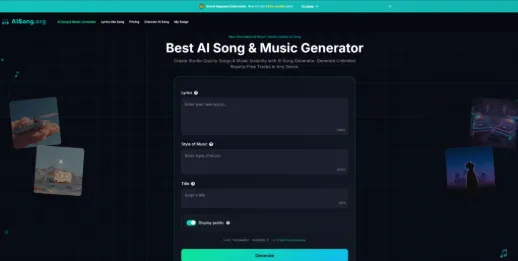
If you have ever tried to “just make a song,” you know how misleading that phrase is. The hardest moment is often the first 30 minutes—when nothing exists yet. You are juggling genre decisions, tempo, chord direction, instrumentation, and structure, while your original idea quietly evaporates. That is why an AI Song Generator can be useful in a very specific way: it helps you externalize an idea fast enough to keep your momentum. In my own tests, I did not treat it like a vending machine for perfect tracks. I treated it like a fast way to get something audible so I could react, correct, and refine.
Why “Speed” Matters More Than People Admit
In creative work, time is not just time—it is attention. When you are building music traditionally, the early phase can be heavy on setup:
- finding the right groove,
- deciding the harmonic palette,
- choosing an instrument stack,
- sketching the arrangement,
- iterating until it feels cohesive.
If your goal is a finished, polished release, that effort is justified. But if your goal is to test ideas—especially for content, prototypes, or early songwriting—waiting hours for a first draft can be a poor trade.
PAS: The friction pattern
- Problem: You have a clear concept, but no fast way to hear it.
- Agitation: Without audio, you cannot judge what works; you either stall or settle for stock music.
- Solution: Generate drafts quickly, then invest production time only in the directions that earn it.
What the Tool Actually Feels Like: A “Translator” Between Intent and Sound
A useful mental model is that the generator is not “composing for you” so much as translating your intent into a playable sketch. You provide:
- a style reference (genre + mood),
- a pacing cue (tempo/energy),
- an instrument preference,
- sometimes a structural hint.
It responds with an audio draft that you can evaluate. In my testing, the practical benefit was that I could compare directions back-to-back, instead of guessing in my head.
Two Ways to Start: Choose Based on Your Input Type
1) You have a vibe, not lyrics (Description-to-Music)
This is the fastest route for:
- background music,
- theme sketches,
- “mood boards” for video,
- early composition ideas.
My observation: prompts became more reliable when they included a few fixed anchors:
- bpm range,
- 2–3 main instruments,
- energy curve (“restrained verse, bigger chorus”),
- what to avoid.
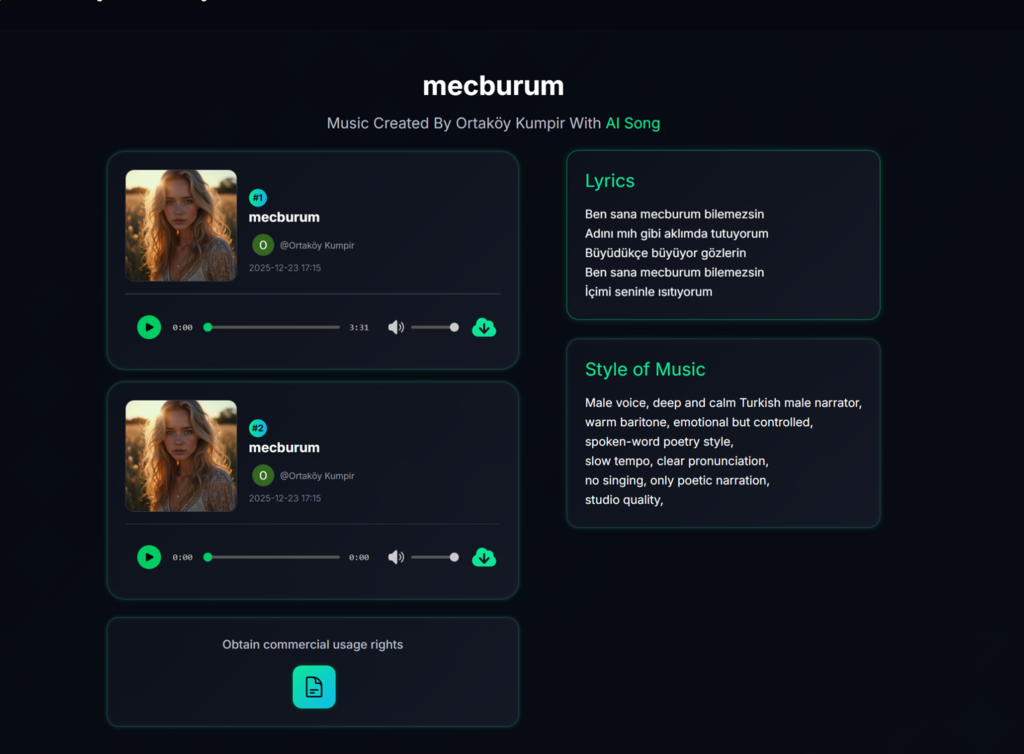
2) You have lyrics already (Lyrics-to-Song)
This route is more constrained because the system has to map syllables into rhythm and phrasing.
My observation: lyric meter matters. When lines were too uneven, the vocal phrasing sometimes sounded unnatural. Rewriting a handful of lines often improved results more than changing the genre.
A Different Comparison: This Is Not “DAW vs AI”—It’s “Decisions vs Labor”
People often compare tools based on “quality.” In practice, the more meaningful comparison is what each approach optimizes for:
- DAWs optimize for precision and control.
- Human producers optimize for taste and interpretation.
- Stock libraries optimize for instant licensing and consistency.
- Generators optimize for rapid draft generation and directional exploration.
That difference matters because your project might need speed today and precision tomorrow.
Comparison Table: Direction-Finding vs Production-Finishing
| Decision Point | AI Song Generator Drafting | Traditional DAW | Producer/Composer | Stock Music |
| “Is this vibe right?” | Fast: generate variants quickly | Slow unless you already have templates | Medium: requires briefing time | Medium: search and audition |
| “Can we test 5 options today?” | Yes, usually | Possible, but labor-intensive | Rarely practical | Depends on library depth |
| “Can we surgically edit one bar?” | Limited | Excellent | Excellent | Not possible |
| “Will it sound identical every time?” | Not always; prompts vary | Yes (deterministic workflow) | Mostly yes | Yes (same track) |
| Best moment to use it | Early exploration | Mid-to-late refinement | High-stakes finalization | When you need safe filler |
What I Learned: The Generator Rewards Clear Constraints, Not Big Words
The temptation is to write a poetic prompt. The better approach (in my experience) is to write a production brief. Three elements improved consistency:
1) Define the role of the music
- “background bed for voiceover”
- “energetic intro sting”
- “emotional lift for montage”
2) Pin down the sonic palette
- “clean guitar, warm bass, tight kick”
- “soft pads, minimal percussion”
- “bright synth lead, gated reverb snare”
3) Add an “avoid list”
This is underrated. It reduces unpleasant surprises.
- “avoid harsh distortion”
- “avoid overly busy hi-hats”
- “avoid abrupt tempo changes”
Realistic Limitations (And How to Work With Them)
1) Outputs can be prompt-sensitive
Small changes in wording may shift arrangement or harmonic color. I found it helped to change one variable per iteration.
2) Iteration is part of the workflow
Expecting “one-and-done” is the quickest path to disappointment. Expecting “drafts” makes the experience feel predictable.
3) Vocal results vary more than instrumentals
When vocals were present, intelligibility and phrasing fluctuated more than the groove did. Lyrics with consistent meter reduced those issues.
4) Genre complexity changes the hit rate
Straightforward pop, ambient, and lo-fi stabilized faster. Dense hybrid genres required more generations to feel cohesive.
A Practical Workflow That Made It Feel Reliable
This is the loop that worked best for me:
- Generate 3 drafts with the same prompt.
- Pick the best one and note what’s working (groove, chord tone, hook).
- Rewrite the prompt with one correction:
- “same vibe, but slower”
- “same groove, but less busy percussion”
- “bigger chorus lift”
- “same vibe, but slower”
- Generate 2 more and compare.
- Stop once the direction is clear; only then invest in polish.
This approach made the tool feel less like chance and more like controlled exploration.
Licensing and Commercial Use: Be Precise About the Details
If you are using output commercially (client projects, ads, distribution), it is worth reading the service terms closely. In practice, “royalty-free” and “commercial use” claims in marketing can coexist with specific platform conditions. If the use case is high-stakes, I would not rely on assumptions—verify the permissions that apply to your plan and your output.
A Neutral Reference Point (If You Want Broader Context)
For a more general, non-product-specific view of generative AI progress in creative work, neutral research reporting such as the Stanford AI Index can be helpful. It does not endorse tools; it frames capability trends and adoption patterns with a measured tone.
Who This Helps the Most
High value
- creators shipping frequent video content,
- indie builders who need quick “sound prototypes,”
- lyric writers without a production workflow,
- teams exploring “brand sound” early.
Lower value
- projects requiring surgical control over arrangement and mix,
- signature releases where every detail must be intentional,
- sessions where a human producer’s interpretation is the point.
Closing: Think of It as a Draft Engine, Not a Finish Line
In my experience, an AI song generator is most useful when you treat it as an accelerator for the first draft—the part that usually costs the most time per unit of certainty. It gives you something audible quickly, so you can make better decisions faster. If you then bring human taste—your own or a collaborator’s—you can turn those drafts into something truly intentional.