

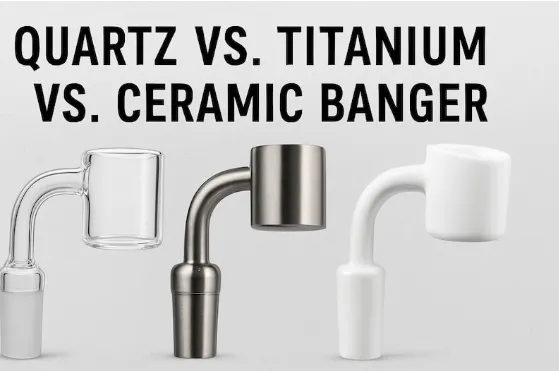
Choosing the right banger or nail is crucial for maximizing the performance of your concentrate rig, as it directly impacts heat time, flavor, and durability. With quartz, titanium, and ceramic being the most popular options, deciding which material best suits your needs can be confusing. This guide breaks down the pros and cons of each, comparing heat retention, flavor purity, and longevity, to help you make an informed decision and find the perfect engine for your sessions.
Quartz: The Flavor King
Quartz has become the gold standard for many concentrate enthusiasts, and for good reason. Its primary advantage is flavor purity. Being highly inert, quartz doesn’t impart any taste, allowing you to experience the full, nuanced terpene profile of your concentrates. It also heats up relatively quickly (typically 15-30 seconds with a good torch). The main drawback is its moderate heat retention; you might need to reheat more often during longer sessions. While durable against heat stress, high-quality quartz bangers can still crack or break if dropped, especially when hot.
- Best for: Flavor purists, low-temp enthusiasts, users who prioritize taste above all else.
- Pros: Best flavor, relatively fast heat-up.
- Cons: Moderate heat retention, can break if dropped.
Titanium: The Indestructible Workhorse
Titanium nails are renowned for their unmatched durability. You can drop a titanium nail, overheat it, and it will likely survive without issue, making it a favorite for travel or group settings. It also heats up extremely quickly (often in under 15 seconds) and boasts excellent heat retention, remaining hot for extended periods. However, titanium is not inert like quartz. Some users report a slight metallic taste, especially at higher temperatures, which can interfere with delicate terpene flavors. It’s crucial to ensure you’re buying medical-grade (Grade 2) titanium, as lower grades can be unsafe.
- Best for: Durability seekers, high-temp users, travel/portable setups, beginners concerned about breakage.
- Pros: Virtually indestructible, fastest heat-up, excellent heat retention.
- Cons: Can impart a slight metallic taste, requires seasoning, quality varies (must be Grade 2).
Ceramic: The Heat Retention Champion
Ceramic nails excel in one key area: heat retention. Once heated (which takes the longest of the three, often 30-45 seconds or more), ceramic holds its temperature exceptionally well, making it ideal for longer, relaxed sessions or sharing. Like quartz, it’s inert and provides excellent flavor purity. However, ceramic is the most fragile of the three materials. It’s highly susceptible to cracking from thermal shock (heating or cooling too quickly) and will almost certainly break if dropped.
- Best for: Users prioritizing long heat retention, relaxed sessions, and flavor enthusiasts who don’t mind longer heat-up times.
- Pros: Best heat retention, excellent flavor.
- Cons: Slowest heat-up, most fragile (prone to cracking/breaking).
Making the Choice: It’s About Priorities
There’s no single “best” material; the right choice depends entirely on what you value most.
- If flavor is your absolute top priority, quartz is likely your winner.
- If durability and fast heating are paramount, titanium is hard to beat.
- If you want the longest-lasting heat for relaxed sessions and great flavor, ceramic might be your ideal match, provided you handle it carefully.
Many enthusiasts eventually own bangers made from multiple materials to suit different situations. Online headshops like Smokemega often carry a wide selection, understanding that offering variety allows users to find the perfect fit for their specific setup and preferences.
Conclusion: Match the Material to Your Style
Understanding the unique properties of quartz, titanium, and ceramic empowers you to choose a banger that truly enhances your concentrate experience. By considering your priorities – whether it’s the purest taste, rugged durability, or extended heat – you can confidently select the material that aligns perfectly with your needs and preferences, ensuring satisfying sessions every time.
Frequently Asked Questions
1. Do I need to “season” a new banger before using it?
Seasoning is primarily recommended for titanium nails. This process involves heating the nail and applying a small amount of concentrate to create a thin, oxidized layer, which helps seal the metal’s pores and can improve flavor. Quartz and ceramic bangers do not require seasoning; in fact, attempting to season them can be detrimental. Always start with a clean quartz or ceramic banger.
2. What’s the difference between a “banger” and a “nail”?
Historically, “nail” was the broader term for the heated surface used with concentrate rigs, often referring to older styles made of glass, titanium, or ceramic that sometimes required a separate dome. A “banger” is a specific, modern style of nail, almost always made of quartz, featuring a bucket shape and a flat bottom. Today, the terms are often used interchangeably, but “banger” usually implies the quartz bucket style.
3. Is one material “safer” than the others?
When sourced correctly, all three materials are safe for their intended use. For titanium, it’s crucial to ensure it’s medical-grade (Grade 2), as lower grades can release harmful off-gasses when heated. High-quality quartz and ceramic are very inert and safe, but cheap, impure versions could potentially exist on the market. Always buy from a reputable source.
4. How important is the thickness of a quartz banger?
Thickness primarily affects heat retention and durability. Thicker quartz will hold heat longer than thinner quartz, allowing for more relaxed sessions or multiple draws per heating cycle. Thicker quartz is also generally more resistant to breaking from accidental drops, though it still requires careful handling.
5. Can I use the same torch technique for all three materials?
While the basic principle is the same (heat the banger, let it cool slightly, apply concentrate), the timing differs significantly. Titanium heats very quickly. Quartz is moderately fast. Ceramic heats the slowest but retains heat the longest. You’ll need to adjust your heating and cooling times based on the material to achieve the optimal temperature for your desired experience (low-temp flavor vs. high-temp clouds).