


Most work truck owners learn the hard way that not all truck beds are built for real jobs. A bed that looks fine on paper can start rattling within months. Storage never quite fits the tools. Weight distribution feels off. Repairs show up earlier than expected. These problems rarely come from misuse. They usually come from buying something that was designed in pieces instead of as a complete system.
The solution is simpler than it sounds. When a truck bed is engineered, built, and tested under one roof, the result is different. In-house engineered truck beds are designed with intention from the start, and that intention shows up every day on the job.
What “In-House Engineered” Actually Means
In-house engineering is not a label. It is a process. The same team that designs the bed also understands how it will be built and how it will be transported on a truck.
Instead of adapting a generic design, engineers start with the chassis, the workload, and the environment. Measurements are precise. Stress points are planned for. Nothing is guessed or passed along to a third party that never sees the final product.
This approach leads to better alignment, stronger welds, and smarter layouts that feel natural in daily use.
Fewer Compromises in the Design Stage
Many truck beds are built around convenience for the manufacturer, not the owner. Pre-set dimensions, standardized compartments, and limited customization all speed up production, but they force the buyer to adjust how they work.
In-house engineered truck beds flip that equation. The design begins with how the truck will actually be used. Tool access, weight balance, tie-down points, and clearance all get attention early, when changes are easy and affordable.
That early focus removes the need for workarounds later.
Built to Match the Truck, Not Just Fit It
A truck bed that technically fits a chassis can still cause problems. Poor mounting alignment leads to uneven stress. That stress shows up as cracked welds, shifting loads, or premature wear on suspension components.
When engineering and manufacturing happen together, the bed is built to match the truck exactly. Mounting points are planned. Load distribution is intentional. The bed becomes part of the truck instead of an add-on sitting on top of it.
This matters even more for heavier applications where small miscalculations grow quickly.
Stronger Quality Control From Start to Finish
Quality control is often treated as a final checkpoint. In reality, quality is built step by step. When everything happens in-house, issues are caught early, not after a problem has already been welded into place.
Materials are selected with the design in mind. Fabrication follows engineering drawings without interpretation gaps. If something needs adjustment, the same team that designed the bed can correct it immediately.
This level of control is difficult to achieve when design and production are separated.
Why Location and Experience Still Matter
Working with a truck bed manufacturer in Kansas brings advantages that are easy to overlook. Many manufacturers in this region serve industries that demand reliability. Agriculture, construction, energy, and fleet operations all expect equipment that holds up under pressure.
That experience shapes how truck beds are engineered. Designs are not theoretical. They are based on years of feedback from real jobs, harsh conditions, and long service cycles.
Local manufacturing also allows for better communication, faster revisions, and clearer accountability.
Long-Term Value Beats Short-Term Savings
Typically, off-the-shelf beds seem more affordable than custom-engineered beds initially; however, the true cost of off-the-shelf beds will occur later due to increased repair costs and longer periods of downtime, as well as unexpected replacement requirements for the truck bed.
Custom-engineered truck beds have the advantage of longer product life, due to their targeted engineering for a single use, versus the cheaper option of using the off-the-shelf option, which is not engineered for one use but for multiple uses. This results in better placement of components and, in addition, the steels are manufactured thicker and, therefore, are stronger than weight-only concerns. The layout of storage locations also has the advantage of reducing the amount of stress placed on doors, hinges, and latches.
Custom-engineered truck beds provide lower overall ownership costs due to fewer failures, which translates to fewer interruptions in work processes.
Better Safety Through Better Design
Safety is not only about labels or compliance. It comes from how equipment behaves when pushed.
A well-engineered bed keeps loads stable. Tools stay secured. Access points reduce awkward movements that cause injuries. Lighting, steps, and handholds are positioned with actual use in mind.
Because in-house engineered truck beds are built around specific work patterns, they tend to support safer habits without forcing them.
Easier Customization Without Guesswork
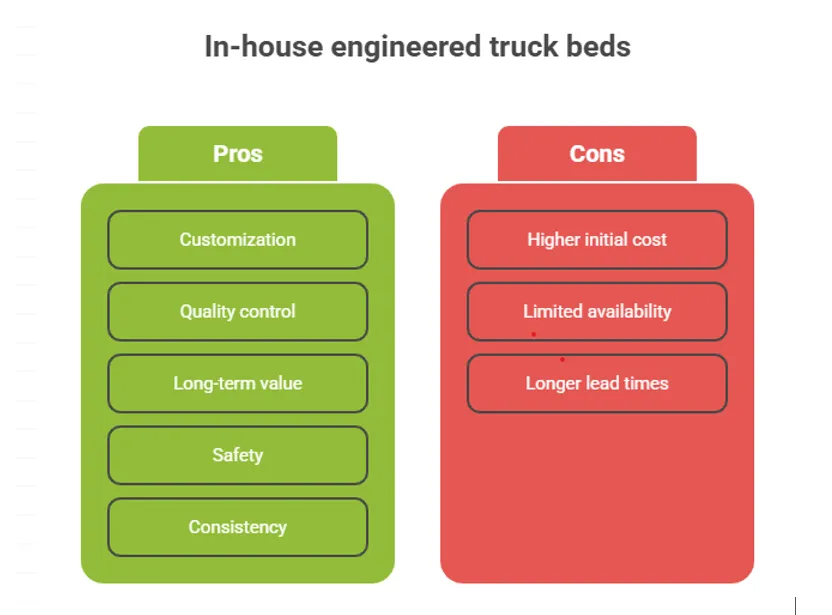
Customization does not always mean complexity. When engineering is handled internally, adding or adjusting features becomes more predictable.
Need a compartment resized, a rack repositioned, or a gate reinforced? These changes can be engineered properly instead of being improvised on the shop floor. That keeps the integrity of the entire structure intact.
For fleets and specialty operators, this flexibility is often the deciding factor.
Consistency for Fleets and Growing Operations
Fleet managers value consistency more than flash. When beds are engineered and built by the same manufacturer each time, the results are repeatable.
Measurements stay consistent. Installation times stabilize. Drivers know what to expect when moving between vehicles. Maintenance becomes more predictable because components wear at similar rates.
A Truck Bed Manufacturer in Kansas with in-house engineering capabilities can support that level of consistency over the years, not just one build.
Conclusion: A Smarter Way to Think About Investment
A truck bed is not just a platform. It is a tool that either supports your work or quietly works against it.
In-house engineered truck beds are a smarter investment because they reduce compromise. They align design, manufacturing, and use into a single process. The result is equipment that fits better, lasts longer, and performs more reliably under real conditions.
For owners who rely on their trucks every day, that reliability is not a luxury. It is the foundation of getting work done without unnecessary friction.